
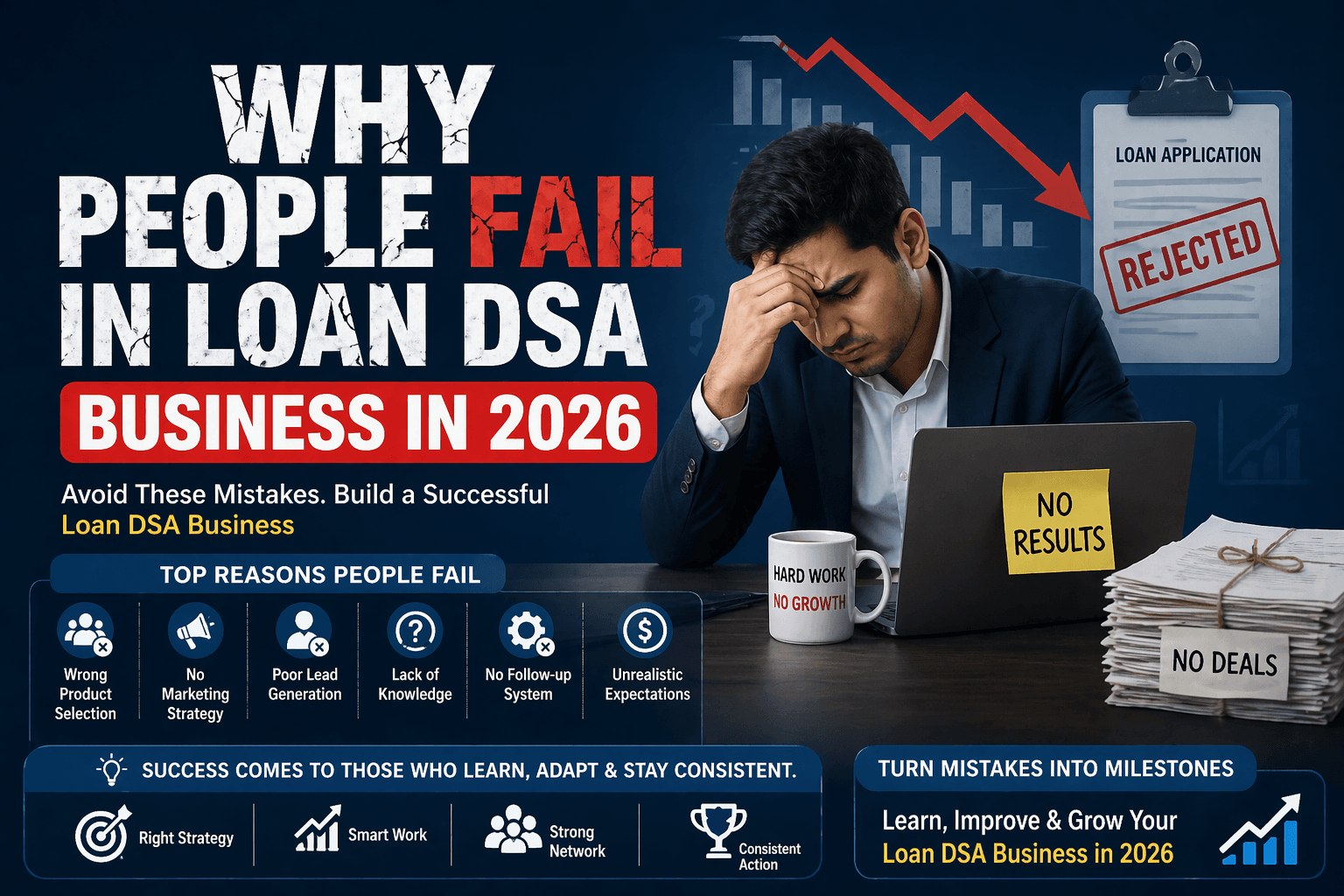
Why people fail in DSA business?
The Direct Selling Agent (DSA) business in the financial sector—especially in loans and credit services—has become one of the most attractive opportunities in India. With low investment, flexible working hours, and the promise of high commissions, thousands of individuals enter this field every year.
Table of Contents
ToggleHowever, there’s a side of the story that most people don’t talk about.
Despite the apparent ease of entry, a majority of DSA agents fail within their first year. They either quit due to low income, frustration, or lack of results. The problem is not the business model itself—it’s the lack of understanding, strategy, and execution.
This article uncovers the hidden reasons why people fail in the DSA business, along with practical insights and proven strategies to help you avoid those mistakes and build a sustainable income.
1. Lack of Deep Industry Knowledge
Most beginners enter the DSA business with a very superficial understanding of how lending works. They believe that their job is simply to connect a borrower with a bank. But in reality, the role of a DSA is much more complex.
You need to understand:
- Credit policies of different banks and NBFCs
- CIBIL score impact and credit profiling
- Income assessment methods
- Risk evaluation criteria used by lenders
Without this knowledge, you cannot:
- Filter the right clients
- Guide them properly
- Improve approval chances
Result: High rejection rates and loss of credibility.
Solution:
Invest time in learning the financial ecosystem. Study different loan products, understand eligibility criteria, and stay updated with changing policies.
2. No Structured Lead Generation System
One of the biggest reasons people fail is because they rely on random or inconsistent lead sources.
Initially, they depend on:
- Friends and family
- Personal contacts
- Occasional referrals
But once this limited network is exhausted, their business stops. DSA is not a one-time sale business—it requires a continuous flow of leads.
Common mistakes include:
- Buying low-quality leads
- Not investing in marketing
- Ignoring digital platforms
Solution:
Build a multi-channel lead system:
- Social media marketing (Facebook, Instagram)
- Google search visibility
- WhatsApp funnel systems
- Local partnerships (CA, property dealers, agents)
Consistency in lead generation is the backbone of success.
3. Unrealistic Expectations of Quick Money
Many people enter the DSA business with the mindset of making quick money.
They see others earning commissions and assume:
“I’ll close a few deals and start earning big immediately.” But the reality is very different.
- Building trust takes time
- Understanding client behavior takes experience
- Conversion improves gradually
Early-stage challenges:
- Low conversions
- Client hesitation
- Frequent rejections
When expectations don’t match reality, people lose motivation.
Solution:
Adopt a long-term mindset. Treat the first 3–6 months as a learning and foundation-building phase.
Read More: Fast Approved Personal Loan in 2026
4. Poor Client Profiling and Targeting
A major hidden reason for failure is targeting the wrong audience.
Many DSAs:
- Approach everyone blindly
- Don’t check eligibility before pitching
- Waste time on unqualified leads
This results in:
- Low approval rates
- Wasted effort
- Mental frustration
Solution:
Develop a clear client profile:
- Salaried individuals with stable income
- Self-employed professionals with proper documentation
- Business owners with financial records
Smart targeting increases efficiency and success rate.
5. Weak Follow-Up System
In the DSA business, fortune lies in follow-ups.
Most deals are not closed in the first interaction. Clients take time to decide, compare options, and arrange documents.
However, many agents:
- Fail to follow up consistently
- Lose track of leads
- Do not build relationships
Result: Lost opportunities.
Solution:
- Maintain a lead database (Excel or CRM)
- Schedule follow-ups
- Provide regular updates
- Stay in touch until closure
A strong follow-up system can double your conversions.
6. Inability to Handle Rejections
Rejections are a natural part of the loan industry.
Reasons may include:
- Low credit score
- Insufficient income
- Documentation issues
- Internal bank policies
But beginners often take rejections personally.
They feel:
- Demotivated
- Frustrated
- Doubtful about the business
Reality: Even experienced DSAs face rejections daily.
Solution:
- Analyze each rejection
- Learn from mistakes
- Improve client screening
Success in DSA is not about avoiding rejection—it’s about managing it.
7. Lack of Professionalism
Clients are dealing with financial matters—they expect professionalism.
Common issues:
- Delayed responses
- Lack of communication clarity
- Unorganized process
- No proper documentation handling
This creates distrust.
Solution:
- Communicate clearly and promptly
- Maintain proper documentation
- Be transparent about terms and conditions
- Build credibility through honesty
Professionalism directly impacts your conversion rate.
Read More: Bajaj Finance Business Loan
8. No Personal Branding or Online Presence
In today’s digital world, if you are not visible online, you are losing business.
Many DSAs:
- Do not have social media presence
- Do not build authority
- Depend only on offline work
But modern customers:
- Search online before trusting
- Prefer known andvisible agents
Solution:
- Create a professional Instagram/Facebook page
- Share informative content
- Post client success stories
- Build trust through visibility
Personal branding can turn you into a lead magnet.
9. Dependency on a Single Lender
Relying on only one bank or NBFC is a major limitation.
Every lender has:
- Different eligibility criteria
- Different approval policies
- Different risk appetite
If one bank rejects a case, another might approve it.
Solution:
- Partner with multiple banks and NBFCs
- Understand their strengths
- Match the right client with the right lender
This increases approval chances significantly.
10. Poor Financial Planning
Unlike a salaried job, DSA income is not fixed.
Challenges include:
- Delayed commissions
- Irregular income flow
- Initial low earnings
Many agents quit because they cannot manage finances.
Solution:
- Maintain a financial buffer
- Control expenses
- Plan for income fluctuations
Financial discipline is essential for survival in the early phase.
11. Lack of Consistency and Discipline
Consistency is the most underrated success factor.
Many people:
- Work hard for a few days
- Lose momentum
- Stop taking action
DSA business requires daily effort:
- Lead generation
- Calls
- Follow-ups
- Learning
Solution:
Create a daily routine:
- Fixed working hours
- Daily targets
- Weekly review
Consistency builds momentum—and momentum creates results.
Read More: Hidden Reasons for Loan Rejection
12. Ignoring Skill Development
The DSA business is not just about selling—it’s about:
- Communication
- Negotiation
- Persuasion
- Relationship building
Without improving these skills, growth becomes difficult.
Solution:
- Learn sales techniques
- Improve communication skills
- Study customer psychology
Skill development is a long-term investment.
How to Succeed in DSA Business.? (Quick Tips)
- Build a Lead Engine
- Focus on Quality Over Quantity
- Develop a Strong Network
- Use Technology
- Build Trust, Not Just Sales
- Daily Follow-up
- Make online Presence
- Add multiple lenders
Frequently Asked Questions (FAQs)
1. Why do most DSA agents fail?
Most fail due to lack of lead generation, poor follow-up, and unrealistic expectations.
2. Is DSA business profitable in India?
Yes, it can be highly profitable if done with the right strategy and consistency.
3. How long does it take to succeed in DSA business?
Typically, it takes 3–6 months to build momentum and start generating consistent income.
4. What is the biggest challenge in DSA business?
Generating consistent, high-quality leads and converting them effectively.
5. Can beginners succeed in DSA business?
Yes, with proper learning, discipline, and execution, beginners can achieve success.
Conclusion:
The DSA business is not a shortcut to quick money—it is a serious profession that requires knowledge, strategy, and consistency.
People fail not because the opportunity is bad, but because:
- They underestimate the effort required
- They lack proper systems
- They quit too early
If you approach this business with the right mindset, continuous learning, and disciplined execution, it can become a highly rewarding and scalable income source.
The difference between failure and success in DSA is simple:
“Those who treat it casually fail. Those who treat it like a business succeed.”