DSA vs Corporate DSA Explanation
India’s credit ecosystem is expanding at an unprecedented pace, fueled by digital lending platforms, increasing consumer aspirations, and easy access to financial products. In this fast-changing landscape, Direct Selling Agents (DSAs) have emerged as powerful connectors between lenders and borrowers. But today, the industry is no longer limited to individual agents working independently — it has evolved into structured, scalable business models known as Corporate DSAs.
Table of Contents
ToggleIf you’re planning to enter the loan distribution industry or already working as a DSA, understanding the difference between DSA and Corporate DSA can define your growth, income potential, and long-term success. This detailed 2026 guide will help you understand both models deeply, compare their advantages, and choose the right path.
What is a Direct Selling Agent (DSA)?
A Direct Selling Agent is a person or organization that partners with banks, NBFCs, or fintech companies to source loan customers. They do not lend money themselves but act as intermediaries who connect eligible borrowers with financial institutions.
Core Functions of a DSA
- Identify potential borrowers
- Guide customers in selecting loan products
- Help with document collection
- Coordinate with lenders until loan disbursal
- Earn commission on successful approvals
In simple terms, a DSA is like a sales partner for financial products.
Understanding Individual DSA
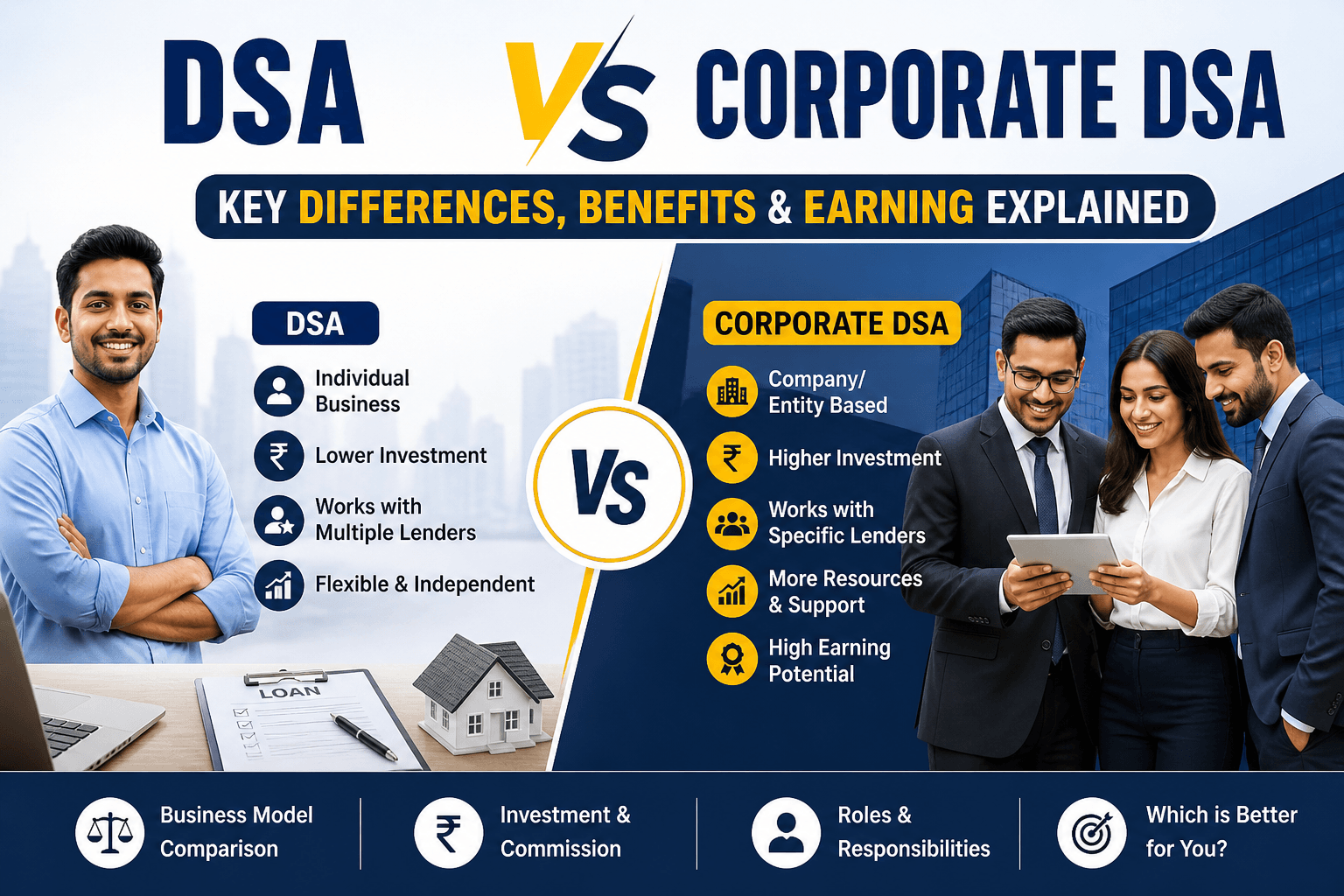
An Individual DSA is a single person who works independently or as a freelancer in the loan distribution space.
Key Characteristics
- Operates alone or with minimal support
- No major infrastructure required
- Earns commission per successful loan
- Usually works locally or within a personal network
Ideal For
- Freelancers
- Insurance advisors
- Real estate agents
Side-income seekers - Beginners in finance field
👉 This model is best for those who want to start small with low risk.
Understanding Corporate DSA
A Corporate DSA is a registered business entity (like Pvt Ltd, LLP, or partnership firm) that operates at a professional and scalable level.
Key Characteristics
- Has a team of employees
- Maintains office or digital infrastructure
- Works with multiple lenders
- Uses marketing, CRM tools, and automation
Ideal For
- Entrepreneurs
- Loan agencies
- Financial consultants
- Startups in fintech sector
👉 Corporate DSAs are designed for large-scale operations and higher profitability.
Read More: Best DSA Providers in India
DSA vs Corporate DSA: Detailed Comparison
1.Basic Structure
| Aspect | Individual DSA | Corporate DSA |
|---|---|---|
|
Ownership |
Single Person |
Company/Firm |
|
Legal Status |
Informal/Basic |
Registered Entity |
|
Oprations |
Small-scale |
Large-scale |
Corporate DSA provides a more professional and organized structure.
2. Setup Cost
- Individual DSA: ₹5,000 – ₹50,000
- Corporate DSA: ₹1 lakh – ₹10 lakh+
Individual DSAs can start with minimal investment, while corporate setups require capital for office, staff, and systems.
3. Income & Commission Potential
Individual DSA
- Commission: 1% – 2%
- Monthly earning: ₹20,000 – ₹1 lakh
Corporate DSA
- Commission: 1.5% – 3%+
- Monthly earning: ₹1 lakh – ₹10 lakh+
👉 Corporate DSAs earn more because they handle higher volume and multiple clients simultaneously.
4. Growth & Scalability
- Individual DSA: Limited growth (depends on personal effort)
- Corporate DSA: Unlimited scalability (team + automation)
👉 If your goal is to build a long-term business, Corporate DSA is the better option.
Individual DSA
- Personal contacts
- Referrals
- Local marketing
Corporate DSA
- SEO & website traffic
- Paid advertising (Google/Facebook Ads)
- Call centers
- CRM-based lead management
5. Lead Generation Methods
Individual DSA
- Personal contacts
- Referrals
- Local marketing
Corporate DSA
- SEO & website traffic
- Paid advertising (Google/Facebook Ads)
- Call centers
- CRM-based lead management
6. Risk & Compliance
- Individual DSA: Low legal responsibility
- Corporate DSA: Must follow compliance rules and agreements
👉 Corporate model involves higher responsibility but also higher rewards.
7. Brand Value
- Individual: Personal identity
- Corporate: Business brand
👉 Corporate DSAs build trust and authority in the market.
Advantages of Individual DSA
1. Easy Entry
You can start quickly without complex formalities.
2. Low Financial Risk
No heavy investment required.
3. Flexible Work Style
Work anytime, anywhere.
4. Suitable for Beginners
Ideal for learning the industry.
Advantages of Corporate DSA
1. High Revenue Potential
More clients = more income.
2. Multiple Bank Partnerships
Better deals and higher commissions.
3. Team Expansion
Hire employees and scale operations.
4. Use of Technology
CRM, automation, and analytics boost efficiency.
5. Strong Market Presence
Build a recognizable financial brand.
How DSAs Earn Money (Complete Breakdown)
1. Commission Per Loan
- Personal Loan: 1% – 3%
- Business Loan: 1.5% – 4%
- Home Loan: 0.5% – 1%
2. Volume Incentives
Banks reward high-performing DSAs.
3. Repeat Customers
Satisfied clients bring referrals.
4. Cross-Selling Opportunities
Sell credit cards, insurance, etc.
Income Example (Realistic Scenario)
Individual DSA
- 12 loans/month
- Avg ticket: ₹2 lakh
- Commission: 1.5%
👉 Monthly income ≈ ₹36,000
Corporate DSA
- 120 loans/month
- Avg ticket: ₹3 lakh
- Commission: 2%
👉 Monthly income ≈ ₹7,20,000
Which One Should You Choose in 2026?
Choose Individual DSA if:
- You want side income
- You have low investment
- You prefer flexible work
Choose Corporate DSA if:
- You want to build a business
- You aim for high income
- You can invest in growth
👉 Smart Strategy: Start as an Individual DSA and gradually expand into a Corporate DSA.
Step-by-Step Guide to Start DSA Business
Step 1: Decide Your Model
Choose Individual or Corporate structure.
Step 2: Partner with Lenders
Apply to banks and NBFCs.
Step 3: Complete Documentation
- PAN Card
- Aadhaar
- Bank details
- Business registration (if corporate)
Step 4: Start Lead Generation
Use offline + online methods.
Step 5: Scale Using Digital Marketing
Focus on SEO, ads, and social media.
Common Mistakes to Avoid
- Relying on a single lender
- Ignoring follow-ups
- Poor documentation handling
- Not using digital marketing
- Lack of customer trust building
Future Scope of DSA Business in India
The future of DSAs looks highly promising due to:
- Growth of fintech companies
- Increase in loan demand
- Digital transformation
👉 Corporate DSAs will dominate due to automation and scalability advantages.
Conclusion
The comparison of DSA vs Corporate DSA is not about which is right or wrong — it’s about what suits your goals.
- Individual DSA is perfect for starting small and learning the business
- Corporate DSA is ideal for building a large, profitable financial enterprise
In 2026, the winners in this industry will be those who combine smart strategy, digital marketing, and customer trust. If you’re serious about long-term growth, transitioning from Individual to Corporate DSA is the smartest move.
FAQs (Frequently Asked Questions)
Q1. What is the main difference between DSA and Corporate DSA?
An Individual DSA works independently, while a Corporate DSA operates as a registered business with a team and infrastructure.
Q2. How much can a DSA earn in India?
Individual DSAs earn ₹20,000–₹1 lakh/month, while Corporate DSAs can earn ₹1 lakh–₹10 lakh+.
Q3. Is DSA business profitable in 2026?
Yes, due to increasing loan demand and digital lending growth.
Q4. Do I need a company to become a DSA?
No, individuals can start without company registration.
Q5. Can I start DSA business with zero investment?
Yes, Individual DSA can start with very low investment.
Q6. Which model is better for long-term growth?
Corporate DSA offers better scalability and income potential.
Q7. How to generate loan leads?
- SEO
- Paid ads
- Social media
- Referral network
Q8. Can I upgrade from Individual to Corporate DSA later?
Yes, many successful DSAs scale their business over time.